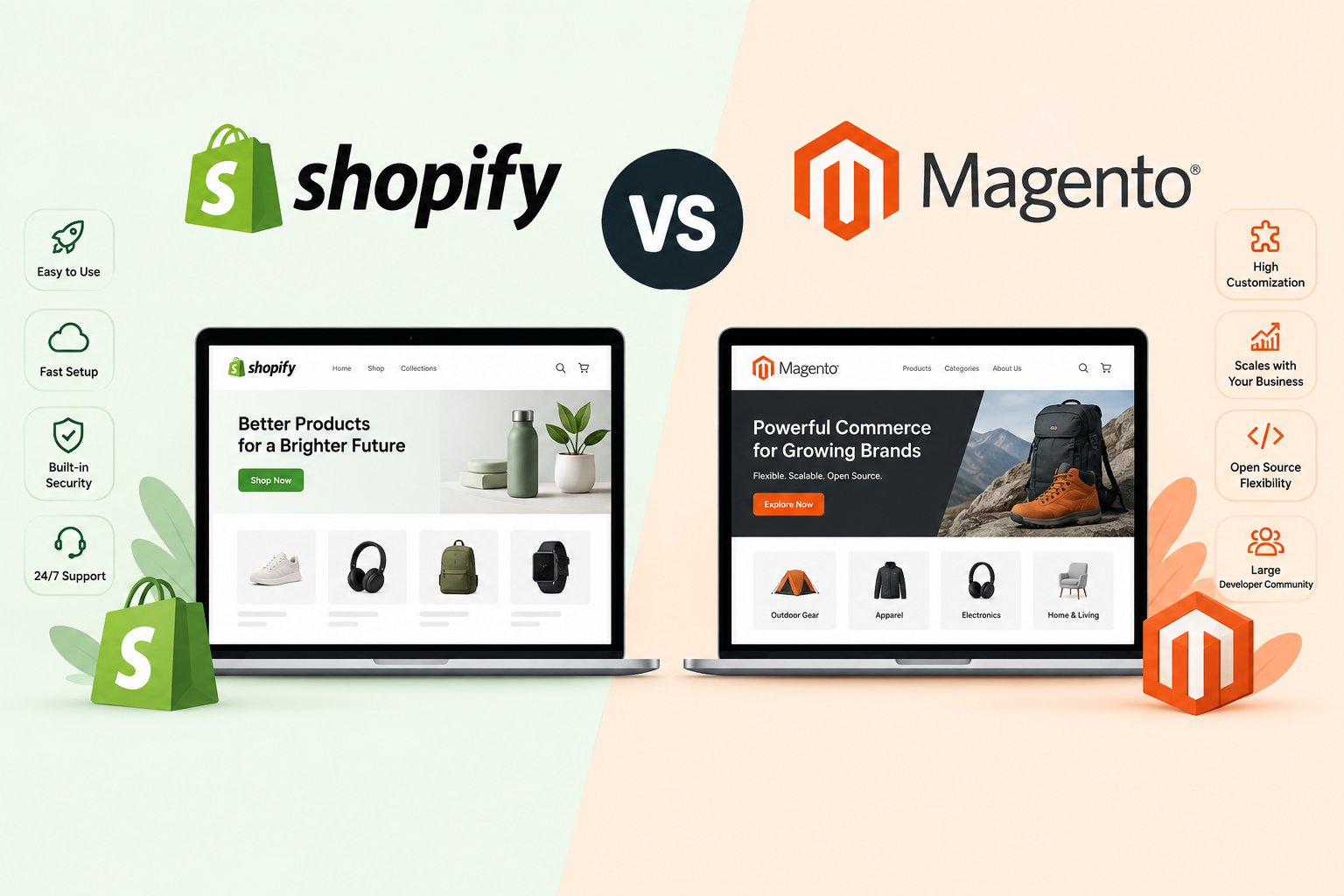
Shopify Plus is a fully managed enterprise SaaS platform. Magento, now sold by Adobe as Adobe Commerce, is open-source software that requires its own hosting, development team, and ongoing maintenance. Shopify Plus suits brands that want lower total cost of ownership, faster iteration, and a platform that handles infrastructure, security, and upgrades for them. Magento suits brands with large in-house engineering teams that need deep backend customization and are prepared to fund the infrastructure that comes with it.
For most DTC and B2B brands between $5M and $500M in revenue, the decision comes down to one question: do you want to run a software project, or do you want to run a store? Below is how the two platforms compare on the factors that decide the outcome, written from the perspective of a Shopify Plus Partner that has migrated brands off Magento since 2012.
Shopify vs Magento at a Glance
| Factor | Shopify Plus | Magento (Adobe Commerce) |
|---|---|---|
| Platform model | Fully hosted SaaS | Open source (self-hosted) or Adobe-hosted PaaS/SaaS |
| Hosting and infrastructure | Included; Shopify manages CDN, scaling, and uptime | Self-hosted, or Adobe Commerce on Cloud at additional license cost |
| Dev resources required | Small team or agency; no server or patching work | Dedicated Magento developers for upgrades, patches, and extension conflicts |
| Platform cost | From $2,300/month (3-year term) or $2,500/month (1-year term); variable fee at high GMV | Open Source: no license fee. Adobe Commerce: roughly $22,000–$125,000+/year on-prem, $40,000+/year on Cloud, scaled to GMV |
| Total cost of ownership | Predictable; platform fee plus apps, payments, and agency support | Typically 2–3x the license fee once hosting, development, and extensions are counted |
| Launch or replatform timeline | 8–16 weeks for most enterprise migrations | 4–9 months typical; longer for heavily customized builds |
| Checkout | Shopify Checkout with Checkout Extensibility, Shop Pay, and one-page checkout | Fully customizable, but each customization is code you maintain |
| Headless capability | Hydrogen and Oxygen (included), Storefront API, any front-end framework | PWA Studio, GraphQL API, or third-party front ends |
| B2B | Built into Shopify Plus (company accounts, price lists, payment terms) | Adobe Commerce B2B module (not in Open Source) |
| Security and PCI | PCI DSS Level 1 handled by Shopify | Merchant responsible for patching, PCI scope, and server hardening |
| Upgrades | Continuous; no version migrations | Quarterly-plus releases; major upgrades are development projects |
| App and extension ecosystem | 10,000+ apps, one-click install | Large marketplace; extensions require developer installation and compatibility testing |
| Best for | Brands prioritizing speed, margin, and a lean tech team | Brands with in-house engineering and unusual catalog or workflow requirements |
How Are Shopify Plus and Magento Built Differently?
The most important thing to understand about Shopify vs Magento is that they are not two versions of the same idea. They are two different operating models.
Shopify Plus is software you rent. Shopify runs the servers, patches the code, absorbs traffic spikes, and ships new features to every merchant at once. Your team works on the storefront, the catalog, the marketing stack, and the integrations. Customization happens through themes, apps, Shopify Functions, and APIs, not by modifying the core.
Magento is software you own. Magento Open Source is free to download and modify. Adobe Commerce adds a licensed layer of enterprise features (B2B, content staging, customer segmentation, Adobe Sensei recommendations) on top of the same core codebase. Either way, you or your agency are responsible for hosting, performance tuning, security patches, version upgrades, and keeping every extension compatible with every release. Adobe now also offers Adobe Commerce as a Cloud Service, a SaaS-style deployment that reduces the operational burden, but it comes with a higher license tier and still sits inside the Adobe ecosystem.
That ownership is Magento's strength and its cost. There is almost nothing you cannot build. There is also almost nothing you can skip maintaining.
Which Platform Has a Lower Total Cost of Ownership?
License and subscription fees are the numbers everyone quotes, and they are the least important part of the comparison. Total cost of ownership is where Shopify Plus and Magento diverge.
Shopify Plus Costs
Shopify Plus starts at $2,300 per month on a three-year term or $2,500 per month on a one-year term. Brands above roughly $1M in monthly GMV move to a variable platform fee tied to revenue, with a negotiable cap at very high volumes. On top of that, most enterprise stores budget for:
-
Apps and integrations: $200–$2,000+ per month depending on the stack
-
Payment processing through Shopify Payments at Plus-tier card rates
-
Agency support or a retainer for ongoing development and optimization
-
ERP, PIM, or 3PL connectors where required
A realistic all-in figure for a $5M–$20M brand is typically $5,000–$15,000 per month, and the platform portion of that is fixed and predictable. We break down every line item in our guide to Shopify total cost of ownership, including the costs merchants most often underestimate.
Magento Costs
Magento Open Source has no license fee. Adobe Commerce is quote-based and scaled to GMV and average order value; Adobe does not publish rates, but aggregated partner estimates for 2026 put on-premise licenses at roughly $22,000 to $125,000+ per year and Adobe Commerce on Cloud at roughly $40,000 to $190,000 per year.
The license, however, is often the smallest recurring line. Budget for:
-
Hosting: from a few hundred dollars per month for a small Open Source store to several thousand per month for high-availability enterprise infrastructure
-
Development and maintenance: security patching, version upgrades, extension conflict resolution, and performance work that never stops
-
Extensions: many paid, and each one needs developer installation and regression testing after upgrades
-
Senior Magento talent: US salaries for experienced Magento developers commonly run $120,000–$180,000, and the talent pool is smaller than for SaaS platforms
Industry analyses consistently put Magento's true TCO at two to three times the license fee. The "free" in Magento Open Source refers to the download, not to the store.
The Comparison That Matters
A brand doing $10M a year on Magento can easily spend $150,000–$300,000 annually on hosting, development, and maintenance before adding a single new feature. The same brand on Shopify Plus spends roughly $28,000–$30,000 on the platform and redirects the balance toward growth work: conversion optimization, retention, and new channels. That reallocation, not the license delta, is why enterprise brands migrate. It's also the core of the argument in Why enterprise brands choose Shopify Plus over Magento.
Development Resources and Speed of Iteration
The second-largest difference between Shopify and Magento is how many engineers it takes to change something.
On Magento, a new promotion mechanic, a checkout tweak, or a catalog structure change usually means a development ticket, a staging deployment, regression testing across extensions, and a release window. Every Magento upgrade is a project with its own risk of breaking custom code. Teams that run Magento well typically have two to four developers dedicated to the platform, or an agency retainer that amounts to the same thing.
On Shopify Plus, most of that work moves to configuration. Merchandisers launch discounts with Shopify Functions and native discount combinations. Marketers edit landing pages in the theme editor. Checkout changes ship through Checkout Extensibility without touching core code. A single developer or a Shopify retainer can support a $50M brand's day-to-day needs, with larger projects scoped separately.
The practical result is that Shopify Plus brands ship changes in days; Magento brands ship them in sprints. For a brand competing on merchandising speed, seasonal campaigns, or rapid A/B testing, that gap compounds every quarter.
Customization and Headless Commerce
This is the category where Magento has historically held the advantage, and it's worth being precise about what remains true in 2026.
Magento's open codebase means you can modify anything: pricing logic, checkout flow, catalog architecture, admin workflows. If your business has requirements that no SaaS platform anticipates — complex configurable products, multi-warehouse allocation rules, or B2B pricing matrices with dozens of variables — Magento can be bent to fit. That flexibility is real.
Shopify Plus has closed most of that gap through its extensibility model rather than by opening its core. Shopify Functions let developers replace backend logic for discounts, shipping, payments, and cart validation. Checkout Extensibility gives Plus merchants control over the checkout experience within a framework Shopify maintains. Metaobjects and metafields handle custom data structures. And for brands that want complete front-end freedom, headless commerce on Shopify with Hydrogen and Oxygen, or with any framework via the Storefront API, delivers full control over the storefront while Shopify runs the commerce engine.
The honest summary: Magento still wins for brands whose core business logic is unusual enough that they need to rewrite the platform. Shopify Plus wins for the much larger group of brands whose customization needs are about experience, merchandising, and integration rather than re-engineering how carts and orders work. Our detailed look at how Shopify Plus solves problems Magento struggles with covers specific scenarios.
Performance, Scalability, and Peak Traffic
Shopify Plus runs on shared infrastructure that absorbs traffic spikes automatically. Flash sales, product drops, and Black Friday are handled by the same platform that processes the world's largest single-day commerce events. Merchants do not provision servers, configure autoscaling, or run load tests before peak season.
Magento performance is a function of how well your infrastructure is built and maintained. A properly architected Magento store on tuned hosting with Varnish, Redis, Elasticsearch or OpenSearch, and a CDN performs well. A neglected one becomes slow and fragile, and peak-season outages on under-provisioned Magento stores are a well-documented pattern. The difference isn't that Magento can't scale; it's that the merchant carries the scaling risk.
Security and Compliance
Shopify Plus is PCI DSS Level 1 compliant as a platform. Merchants inherit that compliance without maintaining their own attestation. Security patches are applied by Shopify across every store simultaneously.
On Magento, security is a merchant responsibility. Adobe releases patches, but applying them, testing them against custom code and extensions, and keeping the hosting environment hardened is on your team. Stores that fall behind on patching become targets; Magento has been the platform behind several widely reported card-skimming campaigns precisely because unpatched installs are common. Adobe Commerce customers can buy extended security support for older release lines; Open Source merchants on end-of-life versions must upgrade to restore coverage.
When Should You Choose Shopify Plus Over Magento?
Shopify Plus is the stronger choice when:
-
You want predictable platform costs and a lean technical team
-
Speed to market matters more than unlimited backend customization
-
Your customization needs center on storefront experience, merchandising, checkout, and integrations
-
You sell B2B and DTC and want both on one platform without a separate module license
-
You need to replatform in a quarter, not a year
-
Your engineering resources are better spent on growth than on infrastructure
This describes the majority of DTC and omnichannel brands we work with, including supplement, beauty, fashion, and consumer electronics brands from $5M to well over $100M in annual revenue. If that's your profile, our Shopify Plus experts page outlines how we approach enterprise builds.
When Does Magento Still Make Sense?
Magento remains the right platform in a narrower set of cases:
-
Your business logic is unusual enough that you need to modify core commerce behavior, not just extend it
-
You already run a mature, well-staffed Magento engineering team and the platform is stable
-
You are deeply invested in Adobe Experience Cloud and want native integration with Adobe Experience Manager, Target, and Analytics
-
You operate highly complex multi-entity, multi-currency, or multi-warehouse setups with custom fulfillment rules that would require heavy workarounds on SaaS
-
Data residency or hosting-control requirements rule out a multi-tenant SaaS platform
If those conditions apply and your team can sustain the maintenance load, Magento's flexibility is a legitimate advantage. If they don't, that flexibility is expensive insurance against requirements you may never have.
If you’re leaning toward the move, our Magento to Shopify migration page walks through the process, and our Shopify migration services cover every source platform.
Migrating From Magento to Shopify Plus
Most brands reading a Shopify vs Magento comparison are not choosing a first platform. They are on Magento and deciding whether to leave. A Magento to Shopify Plus migration is a well-established path, and the risks are known and manageable.
The work breaks into five phases:
1. Audit and Mapping
Inventory every Magento customization, extension, and integration. Decide what maps to a native Shopify feature, what needs an app, and what needs custom development. This is where TCO projections get validated.
2. Data Migration
Products, variants, customers, order history, and content move via migration tooling and scripted imports. Customer passwords do not transfer, so plan the password reset flow.
3. SEO Preservation
Map every Magento URL to its Shopify equivalent with 301 redirects, preserve metadata, and rebuild internal linking. This step determines whether organic traffic survives the switch.
4. Build and Integrate
Theme development or headless build, app configuration, and ERP, 3PL, and marketing stack integrations.
5. Testing and Launch
Full regression across checkout, payments, shipping, taxes, and integrations, then a cutover with a rollback plan.
Typical enterprise timelines run 8 to 16 weeks. Our Magento to Shopify migration page details the process, and our broader Shopify migration services page covers what a migration from any platform involves. For a wider view of why brands leave legacy platforms, see why migrate to Shopify.
Frequently Asked Questions
Is Shopify better than Magento?
For most brands, yes. Shopify Plus delivers lower total cost of ownership, faster iteration, and managed infrastructure. Magento is better only for brands with large in-house engineering teams that need to modify core commerce behavior.
Is Magento cheaper than Shopify?
Magento Open Source has no license fee, but once hosting, development, extensions, and maintenance are included, its total cost of ownership is typically higher than Shopify Plus for comparable stores. Adobe Commerce licenses alone often exceed Shopify Plus's annual platform cost.
What is the difference between Magento and Adobe Commerce?
Adobe acquired Magento in 2018. Magento Open Source is the free, self-hosted edition. Adobe Commerce is the paid enterprise edition built on the same core, adding B2B, content staging, segmentation, and Adobe integrations, and is available self-hosted, on Adobe's cloud, or as a SaaS cloud service.
How much does Shopify Plus cost compared to Adobe Commerce?
Shopify Plus starts at $2,300 per month on a three-year term, about $27,600 per year. Adobe Commerce is quote-based; industry estimates start around $22,000 per year for the on-premise license and $40,000 per year for Adobe Commerce on Cloud, scaling upward with GMV.
Can Shopify handle enterprise-level catalogs?
Yes. Shopify Plus supports large, complex catalogs with variants, metafields, and metaobjects for custom data, and enterprise brands run hundreds of thousands of SKUs on the platform. Very unusual catalog structures may require app or custom-function support.
Is Shopify Plus good for B2B?
Yes. B2B on Shopify is included with Shopify Plus and covers company accounts, custom price lists, payment terms, and quantity rules, with no separate module license required. On Magento, comparable functionality requires Adobe Commerce rather than Open Source.
Does Shopify support headless commerce like Magento?
Yes. Shopify offers Hydrogen and Oxygen for headless builds, plus the Storefront API for any front-end framework. Magento supports headless through PWA Studio and its GraphQL API, but the merchant hosts and maintains both the storefront and the backend.
How long does a Magento to Shopify migration take?
Most enterprise migrations take 8 to 16 weeks, depending on catalog complexity, the number of integrations, and whether the build is themed or headless. Heavily customized Magento stores sit at the longer end.
Will I lose SEO rankings if I migrate from Magento to Shopify?
Not if the migration is done correctly. A full URL map with 301 redirects, preserved metadata, and rebuilt internal linking protects organic traffic. Rankings typically stabilize within a few weeks of launch when redirects are complete.
Who should stay on Magento?
Brands with mature Magento engineering teams, deep Adobe Experience Cloud investment, or business logic that requires modifying core commerce behavior. If none of those apply, the case for staying is usually cost inertia rather than fit.
About XgenTech
XgenTech is a certified Shopify Plus Partner agency founded in 2012 and headquartered in New York, with 15+ ecommerce experts who have led 320+ Shopify store launches and platform migrations for enterprise and DTC brands, including Transparent Labs, Jacked Factory, Cellucor C4 Energy, Nestlé Purina, Cosori, Levoit, Naeem Khan, and Hirshleifers. Our migration practice has moved brands off Magento, WooCommerce, BigCommerce, and custom platforms onto Shopify Plus.
Deciding Between Shopify and Magento?
If you're weighing a move off Magento, we'll model your total cost of ownership on Shopify Plus, map every customization to its Shopify equivalent, and give you a straight answer on whether the migration pays for itself. Talk to our Shopify Plus team.