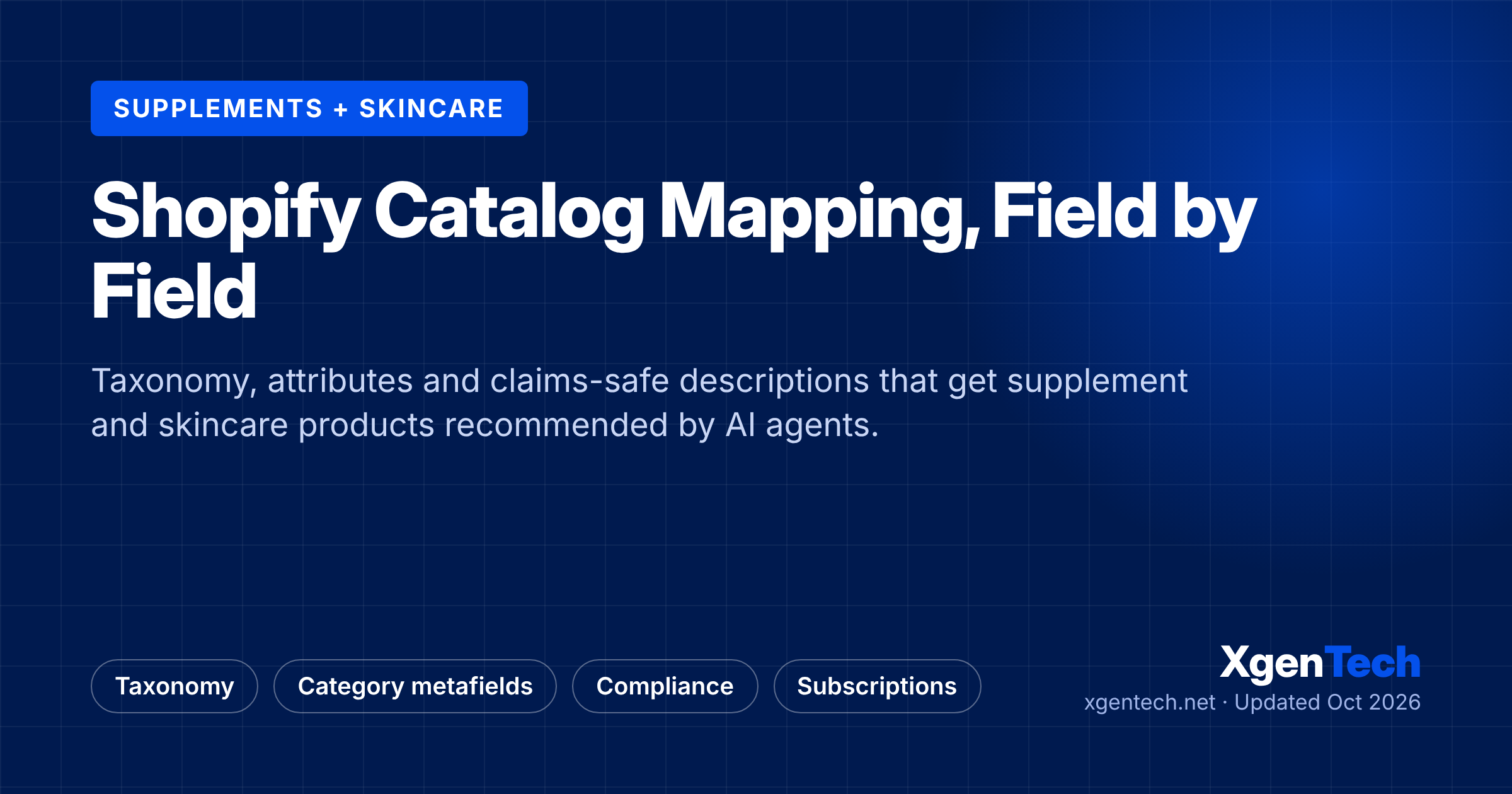
Short answer: Shopify Catalog is the product index that AI agents like ChatGPT, Microsoft Copilot and Meta’s Muse read from. For supplement and skincare brands, three things decide whether you show up:
- The deepest taxonomy category you assign.
- How completely you fill that category’s attributes (category metafields).
- A claims-safe description you can send to AI channels through Shopify Catalog Mapping without changing your storefront.
Supplements and skincare are harder than most categories. They carry ingredient, dosage, form, allergen and skin-type data that shoppers ask agents about directly. They also carry claim rules. OpenAI’s commerce policy, last updated September 29, 2026, prohibits supplements “marketed for weight loss, sexual enhancement, bodybuilding, detoxification, or other health-related effects” in its shopping experiences. How you word your Catalog data now affects whether you are eligible, not just how you rank.
This guide builds on our guide to the best vitamin and supplement brands on Shopify Plus and goes field by field.
Key takeaways
- Assign every product to its deepest category leaf. “Uncategorized products” are ineligible for Shopify Catalog.
- Supplements sit at Health & Beauty > Health Care > Fitness & Nutrition > Vitamins & Supplements. Skincare sits at Health & Beauty > Personal Care > Cosmetics > Skin Care.
- Catalog Mapping can re-source only three fields: product title, product description and product category.
- Shopify’s AI infers attributes, top features and selling points, and Shopify warns these “may vary in accuracy.” Fill the real fields so it has less to guess.
- CBD supplements and prescription or medical products are excluded from Shopify Catalog.
- Never select the “FDA approved” certification value for a supplement or cosmetic.
- Keep a one-time purchase option on hero SKUs. Subscriptions cannot use direct checkout in Copilot, Gemini or Muse.
- Put legal disclosures within the first 6,000 characters of the description.
How Shopify Catalog works, in one paragraph
Products from eligible stores are listed in Shopify Catalog by default. AI agents query it in two ways:
- Global Catalog: searches across all Shopify merchants and clusters identical products under a universal product ID.
- Storefront Catalog: scoped to one store.
ChatGPT, Copilot and Meta’s Muse read from it. Google AI Mode and Gemini read from Google Merchant Center instead, usually through Shopify’s Google & YouTube channel. Your settings for each channel live under Sales channels > Agentic, which we cover in our Agentic Storefronts settings guide.

What Shopify Catalog reads from your products
Fields you control in admin:
- Title, Description and Images
- Product category, Type, Vendor, Collections and Tags
- Barcode (UPC, GTIN, ISBN)
- Variants and option names
- Price, compare-at price (optional to share) and availability
- Store policies, plus FAQs from the Shopify Knowledge Base app
Fields Shopify’s AI may fill in for you:
- Description
- Options
- Product attributes such as material, style and occasion
- Technical specs
- Top features
- Unique selling points
- Condition
The more complete your own data is, the less an inferred field can misstate your formula.
Hard eligibility rules:
- A title and at least one image
- A price above $0
- Published to the Online Store, Hydrogen or Headless channel with an identifiable URL
- Not Unlisted or hidden from search
- A store on the Starter plan or higher that is not password-protected
Step 1: Pick the deepest taxonomy category
Shopify’s Standard Product Taxonomy decides which attributes you can fill. We pulled these paths from Shopify’s live taxonomy on October 13, 2026.
Supplements: Health & Beauty > Health Care > Fitness & Nutrition > Vitamins & Supplements
| Leaf category | Extra attributes on this leaf |
|---|---|
| Amino Acids > Branched-Chain Amino Acid (BCAA), Single Amino Acid Supplements | Amino acid subtype (single amino acid) |
| Creatine | Creatine type |
| Protein Supplements | Protein source, Protein processing type |
| Multivitamin Supplements | Release mechanism |
| Minerals > Calcium, Iron, Magnesium, Multimineral, Zinc | Mineral compound form (multimineral) |
| Single Vitamins > CoQ10, Vitamin A, B, C, D, E, K | (parent attributes) |
| Collagen, Omega Fatty Acids, Sleep Supplements | Parent Vitamins & Supplements attributes |
| Digestive Supplements > Probiotics, Prebiotics & Fiber, Digestive Enzymes and more | Digestive supplement type |
| Herbal Supplements | Herbal supplement health goal, Plant material |
| CBD Supplements | Excluded from Shopify Catalog |
Weight Loss Supplements sit in a separate branch (Fitness & Nutrition > Weight Loss > Weight Loss Supplements) with attributes such as Caffeine content and Stimulant profile.
Skincare: Health & Beauty > Personal Care > Cosmetics > Skin Care
Leaves include:
- Face Serums
- Face Moisturizers
- Facial Cleansers
- Eye Creams
- Toners & Astringents
- Skin Care Masks & Peels
- Anti-Aging Skin Care
- Acne Treatments & Kits
- Lip Balms & Treatments
- Body Butters & Balms
- Skin Care Kits & Sets
- Sunscreen
Sunscreen adds SPF level, PA rating and Sunscreen filter type (chemical, mineral, hybrid).
Do not leave products uncategorized. Shopify lists “Uncategorized products” as ineligible, and it also classifies products from their content, which can differ from the category you set. Copy that leans on CBD or medical language can push a product into an excluded class no matter which category you choose.
Step 2: Fill the category attributes (supplements)
These attributes appear on the parent Vitamins & Supplements category. Names are exactly as Shopify shows them.
| Attribute | What to enter | Watch out for |
|---|---|---|
| Medicine/Supplement form | Powder, Capsules, Softgel, Tablets, Liquid, Chewable tablets and so on | There is no “Gummies” value. Use Chewable tablets or Other, and say “gummies” in the title and description |
| Flavor | Match your variant option values exactly | Mismatched flavor names split your listing |
| Dietary preferences | Vegan, Gluten-free, Keto, Non-GMO, Sugar-free, Kosher, Halal and so on | Only select what you can substantiate |
| Allergen information | Milk, Soybeans, Peanuts, Nuts, Wheat, Eggs and so on | Must match the label |
| Detailed ingredients | Key ingredients and amounts | Repeat the full Supplement Facts as text in the description |
| Supplement health focus | Energy and metabolism, Immune support, Digestive health, Bone and joint support and so on | Keep wording structure/function, not disease |
| Dietary use | Endurance, Recovery, Performance, Muscle building, Weight loss and so on | “Weight loss” and “Muscle building” mirror language OpenAI’s policy targets. Weigh accuracy against ChatGPT eligibility |
| Product certifications & standards | NSF, Informed Choice, GMP, Non-GMO, Vegan | Do not select “FDA approved.” The FDA does not approve dietary supplements before sale |
| Age group, Route of administration | As labeled |
Leaf-specific attributes matter too. A creatine product should set Creatine type (Monohydrate, Micronized monohydrate, HCL and so on). A protein should set Protein source and Protein processing type.
Step 3: Fill the category attributes (skincare)
| Attribute | What to enter | Watch out for |
|---|---|---|
| Suitable for skin type | Dry, Oily, Combination, Sensitive, All skin types and so on | Shoppers ask agents by skin type |
| Skin care effect | Hydrating, Brightening, Anti-redness, Firming, Pore refining and so on | Avoid drug effects you cannot legally claim |
| Cosmetic function | Moisturizing, Exfoliating, Soothing, Cleansing and so on | |
| Active ingredient | The hero active | |
| Constitutive ingredients | Hyaluronic acid, Retinol, Glycolic acid, Salicylic acid, Glycerin and so on | These are common names, not INCI |
| Fragrance level, Product form | As labeled | Shoppers often ask for fragrance-free products, so fill this even when the answer is “none” |
| SPF level, PA rating, Sunscreen filter type | On Sunscreen (and SPF level on Anti-Aging Skin Care) | SPF products are drugs in the US. Follow Drug Facts labeling |
| UVA protection grade | Available on the Skin Care category; fill it for sun-protective products |
Shopify’s taxonomy has no INCI field, so put the full INCI list in the description text. One attribute on Anti-Aging Skin Care is spelled “Anti-agin skin care type” in Shopify’s own data. Use it as is.
Step 4: Map a claims-safe “agent description” with Catalog Mapping
Shopify Catalog Mapping lets you send AI channels a different product title, description or category than your storefront shows, from a metafield or metaobject. You find it under Sales channels > Agentic > Sources > Shopify Catalog > Review product data mapping.
This is the most useful compliance lever for regulated brands. Your storefront copy is written to convert humans. Your agent description should be written to be accurate, extractable and claim-safe.
Suggested structure for an agent description metafield (for example custom.agent_description, multi-line text):
- What it is: brand, product, form, size or count. (“Creatine monohydrate powder, unflavored, 60 servings.”)
- What is in it: serving size and key ingredient amounts in plain text.
- Who it is for and how to use it: usage directions as labeled.
- Dietary and allergen facts: vegan, gluten-free, contains milk and so on.
- Testing and certifications: NSF Certified for Sport, Informed Choice, GMP facility, if true.
- Disclosures: for US dietary supplements, the required FDA statement that the claim has not been evaluated and the product is not intended to diagnose, treat, cure or prevent any disease. For Canada, the NPN and the licensed claim.
Keep disclosures within the first 6,000 characters. Shopify’s ChatGPT requirements say legal disclosures belong in that part of the description.
You can also map a clean title from a metafield, such as “Brand + Product + Form + Size,” if your storefront H1 is written for SEO or campaigns.
Step 5: Add barcodes and tidy variants
- Barcodes (GTIN/UPC) on every variant. Global Catalog clusters identical products under one universal product ID. Shopify calls out the Barcode field in its Catalog guidance, and UCP includes a barcodes field. For supplements also sold on Amazon or in retail, a correct barcode likely helps agents match your listing as the brand’s own offer.
- Consistent option names. Use “Flavor” and “Size” across the catalog, and use Catalog Mapping’s option display names if your internal names are messy.
- Group flavors and sizes. If each flavor is a separate product, Catalog Mapping’s custom combined listings can group them by title delimiter, tag prefix or metafield.
- Variant images. Bind the right tub, bottle or shade image to each variant.
Step 6: Handle subscriptions the agent-friendly way
Shopify requires subscription apps such as Recharge, Skio, Appstle and Seal to save their plans as native Shopify selling plans, which makes them visible to agents. Shopify’s Storefront Catalog exposes selling_plans and a flag showing when a selling plan is required.
But subscriptions are not eligible for direct checkout in Copilot, Google AI Mode and Gemini, or Meta’s Muse. ChatGPT sends buyers to your own checkout, so subscribe-and-save still works there.
Our recommendation: keep a one-time purchase option on every hero SKU so agents can complete a first order, then win the subscription in the post-purchase flow or on your own checkout. Recharge has noted that about 71.5% of renewals process with no storefront visit, so agentic channels mainly affect the first order.
The compliance checklist for supplement and skincare data
This is general information, not legal advice. Have your regulatory counsel review claim language.
Shopify Catalog exclusions
- CBD supplements, prescription and medical products, and sexual health products are not eligible.
- Shopify can change this list at its discretion.
OpenAI (ChatGPT shopping), policy page last updated September 29, 2026
- Prohibits supplements marketed for weight loss, sexual enhancement, bodybuilding, detoxification or other health-related effects.
- Also prohibits misrepresenting key product characteristics.
- The operative phrase is marketed for. Pre-workouts, fat burners and cleanses whose titles and descriptions lead with those benefits carry the most risk. A neutral, ingredient-led agent description is the practical mitigation, though OpenAI’s enforcement has not been published.
Google Merchant Center (feeds AI Mode and Gemini)
- Prohibits false or misleading health claims and products containing ephedra.
- Prohibits supplements containing active pharmaceutical or unapproved dangerous ingredients.
- Restricts DHEA and melatonin products by country.
US FDA and FTC
- Structure/function claims need FDA notification within 30 days of marketing and the standard disclaimer.
- The FTC expects competent and reliable scientific evidence, generally randomized controlled human trials, for health claims.
- Skincare with sunscreen or acne claims is a drug or a cosmetic/drug product, based on intended use.
Health Canada
- Natural health products need a product licence and an eight-digit NPN on the label. Claims in Catalog text should match the licensed claim.
The 10-step implementation plan
- Export products and flag every SKU that is uncategorized.
- Assign each product to its deepest category leaf.
- Fill all category attributes, starting with your top 50 SKUs by revenue.
- Remove any “FDA approved” certification values.
- Add barcodes to every variant.
- Create an agent description metafield with the six-part structure above.
- In Catalog Mapping, point Product description (and optionally title) at your metafields.
- Move disclosures into the first 6,000 characters and have counsel review the claim language.
- Add a one-time purchase option to hero subscription SKUs.
- Check Listing quality under Sales channels > Agentic and fix the lowest scores first, then re-check monthly.
How we approach this for supplement brands
XgenTech has built and scaled Shopify stores for supplement and wellness brands including Transparent Labs, Jacked Factory, Cellucor (C4 Energy) and Trace Minerals, and for skincare brands such as SKNEDIT.
When we audit a supplement or skincare catalog for AI channels, we look for the same gaps first:
- Ingredient panels that exist only as images.
- Flavor and size names that differ across products.
- Categories left on Shopify’s first suggestion.
- Claim language written for conversion rather than compliance.
Fixing that data is some of the highest-return agentic commerce work a supplement or skincare brand can do this quarter.
Frequently asked questions
What is Shopify Catalog Mapping?
It is a Shopify feature that lets you send AI channels a different product title, description or category than your storefront shows, sourced from a metafield or metaobject. It also controls compare-at price sharing and option display names.
What Shopify category should supplements use?
Use the deepest leaf under Health & Beauty > Health Care > Fitness & Nutrition > Vitamins & Supplements, for example Creatine, Protein Supplements, Probiotics or Magnesium. Leaf categories add specific attributes such as Creatine type or Protein source.
What Shopify category should skincare use?
Use the deepest leaf under Health & Beauty > Personal Care > Cosmetics > Skin Care, such as Face Serums, Face Moisturizers or Sunscreen. Sunscreen adds SPF level, PA rating and filter type.
Can supplements be sold through ChatGPT shopping?
Many can be discovered, but OpenAI’s commerce policy, updated September 29, 2026, prohibits supplements marketed for weight loss, sexual enhancement, bodybuilding, detoxification or other health-related effects. Shopify also excludes CBD supplements from its Catalog.
Does Shopify Catalog include supplement subscriptions?
Agents can see selling plans, but subscriptions cannot use direct checkout in Copilot, Gemini or Muse. Keep a one-time purchase option on hero products. ChatGPT sends shoppers to your checkout, where subscriptions work.
Is there an INCI field for skincare in Shopify?
No. Shopify’s Skin Care category includes Active ingredient and Constitutive ingredients using common names, but no INCI field. Include the full INCI list in the description.
Can I hide one supplement from AI channels but keep it in Google search?
Not natively as of October 2026. Shopify’s product-level controls, Unlisted status and the seo.hidden metafield, also remove the product from search engines. You can exclude it from Google’s AI surfaces through your Merchant Center feed, or turn off Catalog access for a whole channel.
Get your catalog mapped by Shopify specialists
XgenTech is a certified Shopify Partner agency founded in 2012 and rooted in New York, with 15+ ecommerce experts. Our AI-powered Shopify solutions team maps product data, taxonomy, metafields and Shopify Catalog for supplement, skincare and wellness brands. See our work for vitamin and supplement brands, or contact us for a catalog readiness audit.
Related reading: